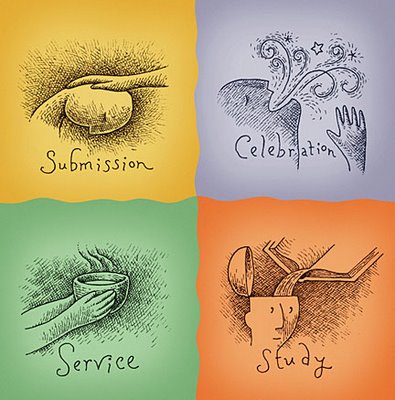
Daniel Kirk, writes about Johnathan Wilson-Hartgrove's latest book Stability here. Worth a read.
His message is simple: there is wisdom in staying put. There is fruit to be borne in committing oneself to a community for a long period of time. There is strength to be had from putting down deep roots.
Showing posts with label Spirituality. Show all posts
Tuesday, 28 February 2012
Thursday, 22 December 2011
TKJG Chapter 5: How Did Salvation Take Over the Gospel?
The creeds articulate what is both implicit and explicit in Paul’s grand statement of the gospel in 1 Corinthians 15. Thus, the gospel is the Story of Jesus as the completion of the Story of Israel as found in the Scriptures, and that gospel story formed and framed the earliest Christians. During the much needed and God ordained Reformation, salvation was clarified in regards to its personal application and necessity. What then happened overtime is that the apostolic gospel was reframed in such as way and so successfully (largely as a result of the powerful evangelistic culture of evangelicalism in American revivalism and then later in America’s culture war between fundamentalists and modernists), that today we are losing contact with the gospel culture.
Tuesday, 20 December 2011
TKJG Chapter 4: The Apostolic Gospel of Paul
1 Corinthians 15 is the best place to begin mapping an understanding of the gospel. Here Paul comes pretty close to defining the word gospel. The gospel is to announce good news about the key events in the life of Jesus and to shout aloud the Story of Jesus Christ as the saving news of God. The gospel though is intimately tied to Israel’s Story as found in the scriptures of the Old Testament. Salvation – the robust salvation of God – is the intended result of the gospel story about Jesus Christ that completes the story of Israel in the Old Testament.
1 Corinthians 15 (TNIV)
PART A
1 Now, brothers and sisters, I want to remind you of the gospel I preached to you, which you received and on which you have taken your stand. 2 By this gospel you are saved, if you hold firmly to the word I preached to you. Otherwise, you have believed in vain. (15:1-2)
PART B
3 For what I received I passed on to you as of first importance: that Christ died for our sins according to the Scriptures,
4 that he was buried,
that he was raised on the third day according to the Scriptures, 5 and that he appeared to Cephas, and then to the Twelve.(15:3-5)
PART C
20 But Christ has indeed been raised from the dead, the firstfruits of those who have fallen asleep. 21 For since death came through a human being, the resurrection of the dead comes also through a human being. 22 For as in Adam all die, so in Christ all will be made alive. 23 But in this order: Christ, the firstfruits; then, when he comes, those who belong to him. 24 Then the end will come, when he hands over the kingdom to God the Father after he has destroyed all dominion, authority and power. 25 For he must reign until he has put all his enemies under his feet. 26 The last enemy to be destroyed is death. 27 For he “has put everything under his feet.” Now when it says that “everything” has been put under him, it is clear that this does not include God himself, who put everything under Christ. 28 When he has done this, then the Son himself will be made subject to him who put everything under him, so that God may be all in all. (15:20-28)
1 Corinthians 15 (TNIV)
PART A
1 Now, brothers and sisters, I want to remind you of the gospel I preached to you, which you received and on which you have taken your stand. 2 By this gospel you are saved, if you hold firmly to the word I preached to you. Otherwise, you have believed in vain. (15:1-2)
PART B
3 For what I received I passed on to you as of first importance: that Christ died for our sins according to the Scriptures,
4 that he was buried,
that he was raised on the third day according to the Scriptures, 5 and that he appeared to Cephas, and then to the Twelve.(15:3-5)
PART C
20 But Christ has indeed been raised from the dead, the firstfruits of those who have fallen asleep. 21 For since death came through a human being, the resurrection of the dead comes also through a human being. 22 For as in Adam all die, so in Christ all will be made alive. 23 But in this order: Christ, the firstfruits; then, when he comes, those who belong to him. 24 Then the end will come, when he hands over the kingdom to God the Father after he has destroyed all dominion, authority and power. 25 For he must reign until he has put all his enemies under his feet. 26 The last enemy to be destroyed is death. 27 For he “has put everything under his feet.” Now when it says that “everything” has been put under him, it is clear that this does not include God himself, who put everything under Christ. 28 When he has done this, then the Son himself will be made subject to him who put everything under him, so that God may be all in all. (15:20-28)
Saturday, 3 December 2011
Advent - Part 2
During Advent we reflect with anticipation, excitement and hope on the coming of the Messiah. We contemplate the birth narratives of the gospels and the expectation of the Jewish people longing for Messiah. What must life have been like for them? What did the coming of Messiah mean for them? What does the coming of Jesus mean for me and for my family and community (local and global)? We look at areas in our own lives where we are in need of Jesus to presence himself and bring light and hope. We look at the world we live in and its brokenness and need of the Divine Saviour. We smile confidently rather than despair. There is hope. There is a new chapter that had begun, is beginning and will take place.
However we wait.
We wait.
Still waiting.
Yep even now, still waiting.
Waiting isn’t something we are always good at. Advent is about pregnant expectancy. As glamorous as that might sound and as exciting as it might be to have a new baby on the way (we’re counting down to the arrival of our third), pregnancy is full on. Ask any mum!
Morning sickness, aches and pains, hard to breath, hard to get around, hard to carry on with life, tired, exhausted, emotional and so on. Yet a mum pushes on with a smile on her face.
Often that’s what our waiting in life is like, we’re confident, we’re smiling, we have hope, but... When’s this going to end? How much longer do I have to wait? I feel terrible, Jesus where are you? I need you now! This world needs you now!
Advent though encourages us not to shy away from this waiting but rather to be still, to be at peace, to trust God in the midst of our waiting. We don’t wait hopelessly though. We wait knowing that Christmas is coming.
However we wait.
We wait.
Still waiting.
Yep even now, still waiting.
Waiting isn’t something we are always good at. Advent is about pregnant expectancy. As glamorous as that might sound and as exciting as it might be to have a new baby on the way (we’re counting down to the arrival of our third), pregnancy is full on. Ask any mum!
Morning sickness, aches and pains, hard to breath, hard to get around, hard to carry on with life, tired, exhausted, emotional and so on. Yet a mum pushes on with a smile on her face.
Often that’s what our waiting in life is like, we’re confident, we’re smiling, we have hope, but... When’s this going to end? How much longer do I have to wait? I feel terrible, Jesus where are you? I need you now! This world needs you now!
Advent though encourages us not to shy away from this waiting but rather to be still, to be at peace, to trust God in the midst of our waiting. We don’t wait hopelessly though. We wait knowing that Christmas is coming.
- Waiting slows us down
- Waiting gives us time and space to gain perspective
- Waiting helps us to discriminate between the good, the better and the best
- Too easy to go through live without pausing. To caught up in life that without realising it we’re all of a sudden following the wrong star.
- Christmas becomes about consumables, candy canes, stocking fillers, over indulgence, a fat man in a red suit – all those things we love and we lose sight of ‘Christ with us.’
- Same can happen in life, we go so fast, move so quickly from one thing to the next that we forget that this life is about so much more than this life.
- If we do not learn to wait, we can allow ourselves to assume that one thing really is as good as another. Just not the case.
Advent, when we engage in the season, relieves us of our commitment to the frenetic fast-paced norms of our world.
It slows us down. It makes us think. It makes us look beyond today to the great ‘tomorrow’ of life, where Jesus restores all things and there are no more tears, pain, or heartache.
And while we wait we remember we are invited to work towards that end!
We’re not to get caught up in the pursuit of chocolate Santa’s, socks, undies, candy canes and i-presents, but rather the pursuit of justice and peace.
We’re to get caught up in the story of Jesus and the mission of Jesus in the world. Allowing that story to reframe the story of our lives.
Friday, 2 December 2011
Advent - Part 1
The Liturgical Year
The Liturgical Year or the Christian Calendar is a way of ordering one’s year that has evolved within Christian tradition over the centuries. Different Christian traditions follow slightly different forms of the calendar with different readings from the bible on different days etc, but in general they all follow the same rhythm.
The way the Liturgical Year works is that it is ordered around the story of Jesus, his life and ministry and longed for return. Its beauty is that it takes us places in prayer, contemplation, study, and celebration that often we might more naturally shy away from. Christmas is a wonderful celebration. Resurrection Sunday is a day of new life and possibility. Pentecost reminds us of the life giving empowerment of the Holy Spirit. They are pretty easy to celebrate.
Lent though reminds us of the trials and struggles of life; the difficulties and the heartaches. Easter Friday takes us to place of what seems to be abandonment and hopelessness. Ordinary time confronts us with the mundane reality of life but that Christ is present.
The real power of the liturgical year is not the feasts, celebrations, seasons and rituals, the real power is its capacity to touch and plumb the depths of the human experience, to stir the human heart. By walking the way of the life of Jesus, by moving into the experience of Jesus, we discover the meaning of our own experiences, the undercurrent of our own emotions, the struggle and the joy, the victories and the heartache of the Christian life. By taking us into the depths of what it means to be a human on the way to God – to suffer and to wonder, to know abandonment and false support, to believe and to doubt – the liturgical year breaks us open to the divine.
Advent
Advent isn’t Christmas. Advent is the four week period leading into Christmas which begins on the fourth Sunday before Christmas. Advent looks forward to the arrival of Christ, the arrival of Emmanuel, God with Us, the hope of the world.
Advent looks forward to the arrival of the Christ child whose birth brings joy to the world. With Mary we magnify God’s name at the announcement that the long promised one is coming soon. Our waiting is full of pregnant expectancy, waiting in anticipation for the full coming of God’s reign of peace. The liturgical colour is blue, signifying hope and the dawning of a new day.
Advent is also an opportunity to re-tell the Christmas story, away from of consumerism and materialism, and back towards anticipation, expectation and the wonder of the incarnation, of God with us, of the long waited arrival of the Messiah in very unspectacular circumstances. Advent is the celebration that there is going to be a new chapter in the story; hope, life, promise, redemption, grace, forgiveness.
Advent from Latin essentially means ‘coming’ but Advent is not about one coming but rather three.
The Liturgical Year or the Christian Calendar is a way of ordering one’s year that has evolved within Christian tradition over the centuries. Different Christian traditions follow slightly different forms of the calendar with different readings from the bible on different days etc, but in general they all follow the same rhythm.
The way the Liturgical Year works is that it is ordered around the story of Jesus, his life and ministry and longed for return. Its beauty is that it takes us places in prayer, contemplation, study, and celebration that often we might more naturally shy away from. Christmas is a wonderful celebration. Resurrection Sunday is a day of new life and possibility. Pentecost reminds us of the life giving empowerment of the Holy Spirit. They are pretty easy to celebrate.
Lent though reminds us of the trials and struggles of life; the difficulties and the heartaches. Easter Friday takes us to place of what seems to be abandonment and hopelessness. Ordinary time confronts us with the mundane reality of life but that Christ is present.
The real power of the liturgical year is not the feasts, celebrations, seasons and rituals, the real power is its capacity to touch and plumb the depths of the human experience, to stir the human heart. By walking the way of the life of Jesus, by moving into the experience of Jesus, we discover the meaning of our own experiences, the undercurrent of our own emotions, the struggle and the joy, the victories and the heartache of the Christian life. By taking us into the depths of what it means to be a human on the way to God – to suffer and to wonder, to know abandonment and false support, to believe and to doubt – the liturgical year breaks us open to the divine.
Advent
Advent isn’t Christmas. Advent is the four week period leading into Christmas which begins on the fourth Sunday before Christmas. Advent looks forward to the arrival of Christ, the arrival of Emmanuel, God with Us, the hope of the world.
Advent looks forward to the arrival of the Christ child whose birth brings joy to the world. With Mary we magnify God’s name at the announcement that the long promised one is coming soon. Our waiting is full of pregnant expectancy, waiting in anticipation for the full coming of God’s reign of peace. The liturgical colour is blue, signifying hope and the dawning of a new day.
Advent is also an opportunity to re-tell the Christmas story, away from of consumerism and materialism, and back towards anticipation, expectation and the wonder of the incarnation, of God with us, of the long waited arrival of the Messiah in very unspectacular circumstances. Advent is the celebration that there is going to be a new chapter in the story; hope, life, promise, redemption, grace, forgiveness.
Advent from Latin essentially means ‘coming’ but Advent is not about one coming but rather three.
- Coming of Jesus, 2000 years ago, the Messiah, Emmanuel, the Saviour.
- Coming of Jesus, as present in our everyday lives today, working in all sorts of beautiful and wonderful ways.
- Coming of Jesus again to put all things right, to restore all things and to bring justice and shalom.
Jesus – past, present, future!
Thursday, 1 December 2011
Spiritual Disciplines or Not Spiritual Disciplines
Don Carson at the Gospel Coalition offers a pretty narrow view of what constitute as and what don't constitute as spiritual disciplines. Essentially he narrows them to bible reading and prayer. I'm more broad in my appreciation of what could be considered a 'spiritual discipline.'
You can read his thoughts and rationale here = D.A Carson 'Spiritual Disciplines'
The point of this post is not to get into a debate or argument with Carson on the issue but rather to offer a different opinion and give you something to think on in regards to what may or may not work as a spiritual discipline in your life i.e. a practice that leads to spiritual growth and development as a Christ follower in areas of right believing, right affections and right living.
My comments on Carson's article...
I think Carson presents a very narrow few of how God can and does work in the lives of His people and of the practices which His people can engage in that as spiritual disciplines, lead to spiritual growth.
You can read his thoughts and rationale here = D.A Carson 'Spiritual Disciplines'
The point of this post is not to get into a debate or argument with Carson on the issue but rather to offer a different opinion and give you something to think on in regards to what may or may not work as a spiritual discipline in your life i.e. a practice that leads to spiritual growth and development as a Christ follower in areas of right believing, right affections and right living.
My comments on Carson's article...
I think Carson presents a very narrow few of how God can and does work in the lives of His people and of the practices which His people can engage in that as spiritual disciplines, lead to spiritual growth.
Yes spirit, spiritual, spirituality are notoriously fuzzy words. There has been massive debate about Christian Spirituality and how that can possible be defined for many years.
I don’t think 1 Cor 2:14 or 1 Cor 3:1 are references to intrinsic reality of humanities make up as created in the image of God, but rather to the regenerate state of certain individuals/communities. There is a big difference.
I love the gospel and I’m not nervous about the language of ‘spiritual disciplines’ extending itself into all sorts of arenas, such as Bible reading, meditation, worship, giving away money, fasting, solitude, fellowship, deeds of service, evangelism, almsgiving, creation care, journaling, missionary work, and more. Popular use may divorce them from specific doctrine Christian or otherwise, but Christian use should always anchor them in the grand narrative of scripture. Indeed I concur with Carson that in general they will only increase one’s ‘spirituality’ with the presence of the Holy Spirit, all being that they are likely still good practices in character development even apart from a recognised knowledge of God.
I think plenty can be listed as a spiritual discipline without being particularly mentioned in Scripture, i.e. despite the bible saying precious little (debatable!) about creation care and chanting mantras.
Yes of course the disciplines can be done for disciplines sake and do not necessarily make one holier than another. When done with an openness to the Spirit they certainly create space to hear from God though, to re-orientate one’s life around the Way of Jesus and to help one grow healthy.
One of my main points of contention is that I would disagree with Carson and 100% assert that Christian responsibilities can and should be labelled as spiritual disciplines. The very running of one's Christian race 1 Cor 9:24-27 (towards orthodoxy, orthopathy and orthopraxy) is exercise in itself. Any movement towards right(eous) living, towards clothing oneself or taking off the old self and putting on the new self Eph 4:22-24, is exercise, discipline, a pressing on, which leads to what can only be described as ‘spiritual growth.’ This does not mean there is nothing special about prayer and the reading of God’s Word, indeed not all disciplines are equal, though all can be healthy. In some seasons people need to lean more into some disciplines than others. Likewise, this does not mean that one is sucked into thinking that growth in spirituality is but conformity to rules. The very acts of creation care, giving away money and fellowship (when truly engaged in, in a disciplined and committed manner) demand growth in love, trust, understanding of the ways of God and the work of the Spirit in filling and empowering us. All practices which can help us in our journey of sanctification, conformity to Jesus Christ and spiritual maturation.
What would you class or not class as a spiritual discipline? What disciplines do you practice that have lead to life in the Spirit and growth in the things of God?
Further reading try...
Grace and peace
Saturday, 11 June 2011
Leading people up the garden path
A discussion came up in a class I teach the other day, about the nature of discipleship and how we determine the growth in someone's Christian life of faith. What arose in the discussion is how, within certain paradigms of church expression, we can be tempted to define personal spiritual growth primarily in terms of narrow definitions of 'leadership' and 'capacity'.
In 'contemporary' Pentecostalism, leadership is certainly the flavour of the decade in terms of priority. This recent emphasis is an entirely understandable response for a church movement historically focused on experience and Spirit-led revival. It is perceived that the problem of the past was a lack of leadership and therefore a resultant lack of focus and implementation of long-term significance etc.
While I understand this emphasis and why it has arisen, I do have some concerns about making certain definitions (e.g. John Maxwell-type versions) of leadership the central focus of church and spirituality on an ongoing basis. The challenge for us, is that the more we talk about leadership as central to what we are doing, it can be the less we actually end up talking about Jesus or our own personal faith etc. In fact, we can end up judging somebody's progress of faith, by how well they express their leadership in certain contexts. If somebody is growing in certain areas of their life e.g. they are punctual, enthusiastic, passionate, practical, directive, a great team player, visionary, inspiring etc - we can therefore assume that they are growing in their faith.
I am quite fond of punctuality myself (despite my somewhat laid-back creative personality)... however, I don't find it listed amongst many of the top biblical concepts for how to know if someone is growing in their faith in Christ. In fact, Paul lists a few such attributes in Galatians, and they include things like gentleness and kindness. In contemporary church how often do we find Christians discussing the way in which they (or others) are growing in gentleness and kindness towards one another? In fact, at times these things can be seen as limiting to one's ability to lead and therefore need to be avoided.
I am not against leadership training or input, but I do think we need to be careful. In the 1st century, many associated wealth as a sign of spirituality and God's blessing - and I think today we need to ensure we don't do the same with leadership or capacity. You can not determine your own (or others) spiritual growth by how many teams or meetings you are committed to. You can not determine it by the percentage of growth in your small groups or various teams etc. If we create churches that equate organisational leadership skills with spirituality and spiritual status, we run the risk of modeling a Christianity that may leave people empty. If we tell people that doing certain things are what matter, and they do those things only to discover they are not where the life of the gospel is actually found, we may breed disillusionment instead of the long-term significance we desire.
We need to ensure that we remember to centre our lives around Christ and his teaching. At times the right Christian response will actually need to override what might seem to be the right 'leadership' response (depending on our definition of leadership) - and we need to be encouraged to make the right choices. Ultimately, Jesus showed his definition of leadership by washing his disciples feet and by going to the cross. And its a path that I would rather avoid.... yet He compels me to follow.
In 'contemporary' Pentecostalism, leadership is certainly the flavour of the decade in terms of priority. This recent emphasis is an entirely understandable response for a church movement historically focused on experience and Spirit-led revival. It is perceived that the problem of the past was a lack of leadership and therefore a resultant lack of focus and implementation of long-term significance etc.
While I understand this emphasis and why it has arisen, I do have some concerns about making certain definitions (e.g. John Maxwell-type versions) of leadership the central focus of church and spirituality on an ongoing basis. The challenge for us, is that the more we talk about leadership as central to what we are doing, it can be the less we actually end up talking about Jesus or our own personal faith etc. In fact, we can end up judging somebody's progress of faith, by how well they express their leadership in certain contexts. If somebody is growing in certain areas of their life e.g. they are punctual, enthusiastic, passionate, practical, directive, a great team player, visionary, inspiring etc - we can therefore assume that they are growing in their faith.
I am quite fond of punctuality myself (despite my somewhat laid-back creative personality)... however, I don't find it listed amongst many of the top biblical concepts for how to know if someone is growing in their faith in Christ. In fact, Paul lists a few such attributes in Galatians, and they include things like gentleness and kindness. In contemporary church how often do we find Christians discussing the way in which they (or others) are growing in gentleness and kindness towards one another? In fact, at times these things can be seen as limiting to one's ability to lead and therefore need to be avoided.
I am not against leadership training or input, but I do think we need to be careful. In the 1st century, many associated wealth as a sign of spirituality and God's blessing - and I think today we need to ensure we don't do the same with leadership or capacity. You can not determine your own (or others) spiritual growth by how many teams or meetings you are committed to. You can not determine it by the percentage of growth in your small groups or various teams etc. If we create churches that equate organisational leadership skills with spirituality and spiritual status, we run the risk of modeling a Christianity that may leave people empty. If we tell people that doing certain things are what matter, and they do those things only to discover they are not where the life of the gospel is actually found, we may breed disillusionment instead of the long-term significance we desire.
We need to ensure that we remember to centre our lives around Christ and his teaching. At times the right Christian response will actually need to override what might seem to be the right 'leadership' response (depending on our definition of leadership) - and we need to be encouraged to make the right choices. Ultimately, Jesus showed his definition of leadership by washing his disciples feet and by going to the cross. And its a path that I would rather avoid.... yet He compels me to follow.
Thursday, 9 June 2011
Worth pondering perhaps?
Random thought for the day...
Renewal is the Spirit of God breathing love, truth, life, hope, faith, and resonance into Christian spirituality through the deconstruction and reconstruction of one or more of the interdependent elements of Christian spirituality; cultural context, theological understanding, mystical experience or practice, and communal expression.
Just thought I'd put it out there.
Renewal is the Spirit of God breathing love, truth, life, hope, faith, and resonance into Christian spirituality through the deconstruction and reconstruction of one or more of the interdependent elements of Christian spirituality; cultural context, theological understanding, mystical experience or practice, and communal expression.
Just thought I'd put it out there.
Subscribe to:
Comments (Atom)