This is stolen from some blog that stole it from some other blog. Credit as possible at the bottome.
In regards to the whole women in ministry / leadership debate which goes on in some circles of the church, though non I move in.
Top Ten Reasons Why Men Should Not Be Ordained
10. A man’s place is in the army.
9. For men who have children, their duties might distract them from the responsibilities of being a parent.
8. Their physical build indicates that men are more suited to tasks such as chopping down trees and wrestling mountain lions. It would be “unnatural” for them to do other forms of work.
7. Man was created before woman. It is therefore obvious that man was a prototype. Thus, they represent an experiment, rather than the crowning achievement of creation.
6. Men are too emotional to be priests or pastors. This is easily demonstrated by their conduct at football games and watching basketball tournaments.
5. Some men are handsome; they will distract women worshipers.
4. To be ordained pastor is to nurture the congregation. But this is not a traditional male role. Rather, throughout history, women have been considered to be not only more skilled than men at nurturing, but also more frequently attracted to it. This makes them the obvious choice for ordination.
3. Men are overly prone to violence. No really manly man wants to settle disputes by any means other than by fighting about it. Thus, they would be poor role models, as well as being dangerously unstable in positions of leadership.
2. Men can still be involved in church activities, even without being ordained. They can sweep paths, repair the church roof, and maybe even lead the singing on Father’s Day. By confining themselves to such traditional male roles, they can still be vitally important in the life of the Church.
1. In the New Testament account, the person who betrayed Jesus was a man. Thus, his lack of faith and ensuing punishment stands as a symbol of the subordinated position that all men should take.
CREDIT: Apparently the top ten list was presented by David M. Scholer on February 20, 1998, at the Fuller Follies at Fuller Theological Seminary, Pasadena, CA. David’s version was taken, with small modifications, from a November 24, 1997 internet communication from W. Ward and Laurel Gasque, who have long been champions of Biblical equality.

Thursday, 10 May 2012


Thursday, 26 April 2012
Can One Church Handle Two Generations?
Here is a link to an article in The Leadership Journal of Christianity Today. Its well worth a read as it discusses the different attitudes and perspectives of a typically 'boomer' Senior Pastor in contrast with that of his typically 'postmodern/millennial' son who is also a Pastor in the church. The back and forth is really good.
It doesn't answer the question though, can one church handle two generations, or more accurately; these two different perspectives on the gospel and ministry?
I'd say the conversation gets a little more intense away from this interview setting.
What do you think?
Peace
Read the article here: Outlooks on Outreach
It doesn't answer the question though, can one church handle two generations, or more accurately; these two different perspectives on the gospel and ministry?
I'd say the conversation gets a little more intense away from this interview setting.
What do you think?
Peace
Read the article here: Outlooks on Outreach
Tuesday, 28 February 2012
Stability
Daniel Kirk, writes about Johnathan Wilson-Hartgrove's latest book Stability here. Worth a read.

His message is simple: there is wisdom in staying put. There is fruit to be borne in committing oneself to a community for a long period of time. There is strength to be had from putting down deep roots.
His message is simple: there is wisdom in staying put. There is fruit to be borne in committing oneself to a community for a long period of time. There is strength to be had from putting down deep roots.
Tuesday, 24 January 2012
Jonathan Martin on Women in Church Leadership
Came across this guy somehow the other day, Jonathan Martin. Never heard of him but loved what he had to write about women in church leadership and where Mark Driscoll has it wrong. Loved his conclusions and the spirit in which he wrote. Checked out his church website too (Renovatus) and their manifesto/vision/values really resonated with me. And... not only that they fuse Pentecostal passion and ancient liturgy. Works for me!
His argument doesn't engage in a critique of the biblical texts, though like most of us egalitarian's he'd be more than happy to go there. He writes from a different angle here and it's worth a read. Here.
His argument doesn't engage in a critique of the biblical texts, though like most of us egalitarian's he'd be more than happy to go there. He writes from a different angle here and it's worth a read. Here.
Friday, 20 January 2012
Forgotten Elements of Leadership in 1 Tim 3:1-7
I’m busy working my way through the so-called “Pastoral Epistles” in preparation for a course I’m teaching in April. While working through this passage, I’ve noticed that within much contemporary preaching and teaching on the topic of leadership, or at least what I’ve experienced, there has been an emphasis on certain elements within this “list of qualifications.” What usually gets discussed or debated is the “one woman man” phrase; whether or not all elders have to be “skilled teachers”; and then “managing one’s household”. It is also taken for granted that those in leadership should not be addicted to alcohol. But what of the other elements in this passage?
Firstly, the passage mentions that those who want to be leaders should be people “against whom no charge can be brought” (Barrett, 58). This indicates someone of impeccable character with no obvious defects in their behaviour. Then the double whammy of “self-controlled” and “self-disciplined.” The first word refers “to being restrained in conduct, self-controlled, level-headed,” while the second is a cardinal virtue in the Graeco-Roman world, a characteristic of those who are in control of their faculties and their responses to stimuli or situations. Such people evoke confidence in their ability to handle crises and make difficult decisions. Then we have the word “respectable” or “dignified” which was often used as an epithet for honourable people.
Then, the one I’ve learnt the most about recently, is “not given to violence.” The word has a wide meaning, including bullying, verbal abuse and physical acts of violence. To the contrary of this negative aspect of character, leaders are called to be “gentle” and those who “create peace,” as opposed to those who cause “fighting”. Gentle, “as a human virtue can almost subsume all virtues into itself, coming to mean a “virtuous equilibrium” that expresses itself in a balance between honesty, tolerance, and gentleness” (Towner). And those who “create peace” or are “peaceable” are those who do not stir up fights, both physical and non-physical, but bring healing and restoration. It is the exact opposite of what is described in Titus 3:9 and 2 Tim 2:23-24.
I wonder what would happen if we restored the balance and gave as much attention to these elements of character and life as we did to the other elements. I wonder what kind of leaders we would produce by focussing on such elements. I wonder if those who are in leadership positions shouldn’t spend a bit more time reflecting on these elements of their biblical “job description.” On a final note, Jesus embodies these virtues perfectly, and it is by implementing his character and concern for others, empowered by the Spirit (Titus 3:5-6), that we will be able to be such leaders in God’s household.
Wednesday, 18 January 2012
I kissed a lady other than my wife...
Yesterday our family and a couple of other families got together for a picnic dinner at the beach. It was awesome to have friends and friends of friends gathered. After a wonderful evening under the setting sun, with kids and Dads jumping in the shallows, and mums relaxing and chatting on blankets (well away from the water) it was time to return all the starfish to the ocean and head home. Friends of our friends packed up first and began their farewells. Kisses were exchanged between our friends and their friends. I however was expecting a wave or a nod or a ‘see you next time’ especially as I did not know this couple that well. However I was approached and it was immediately obvious that the ‘farewell kiss of peace’ was about to be offered.

Now this is an extremely biblical and Christian practice, take a look...
Romans 16:16 — "Greet one another with a holy kiss"
In my naivety it turned out we had a half crash and I ended up kissing a lady half on the lips that wasn’t my wife. (Though my wife was right there and was next in line for a kiss). It was all very straight forward, beautiful really (in the most innocent sense), and we said our farewells. I quickly turned to my wife and our friends exclaiming how; “I hope she’s not going home enraged, complaining to her husband that I feinted left but went right at the last moment! I’d prefer not to have a black eye coming my way at the next family picnic.”
All in all it wasn’t really uncomfortable at all and it was a reminder that people are precious. Life time friends are precious. New acquaintances are precious.
God saw that it was not good for Adam to be alone and he created Eve. As well as that, God gave humanity each other, a whole community of people to journey with and stand with and have stand alongside you in the journey of life. That’s beautiful. Appreciate the people around you today.
Now this is an extremely biblical and Christian practice, take a look...
Romans 16:16 — "Greet one another with a holy kiss"
1 Corinthians 16:20 — "Greet one another with a holy kiss"
2 Corinthians 13:12 — "Greet one another with a holy kiss"
1 Thessalonians 5:26 — "Greet all the brothers with a holy kiss"
I Peter 5:14 — "Greet one another with a kiss of love"
There is something beautiful and wonderful about a kind of friendship or even simple appreciation of the ‘other’ where greeting and fare welling is accompanied with a purely agape kiss. Amongst many other characteristics it is one of the beautiful parts of the Mediterranean cultures of Italy and Greece etc. Obviously it can be distorted, but at its best it is a wonderful affirmation of the value and worth of others, be they long time friends or people you’ve just met at a picnic at the beach. I love it.
The only thing is... it’s not something much practiced in my circle of friends.(Though I do know of one friend who on moving to Australia greeted with the kiss explaining it as how people rolled back in NZ. Then on returning from Australia greeted with a kiss explaining it as how people rolled back in Australia. Nice work!)
The long and the short of it is that I’m not an expert of the “greet one another with a holy kiss.” Do you go left or do you go right? Is it like road rules? Keep left at all times? What about if you are about to kiss someone who drives on the right hand side of the road? You’re going to have a collision. In my naivety it turned out we had a half crash and I ended up kissing a lady half on the lips that wasn’t my wife. (Though my wife was right there and was next in line for a kiss). It was all very straight forward, beautiful really (in the most innocent sense), and we said our farewells. I quickly turned to my wife and our friends exclaiming how; “I hope she’s not going home enraged, complaining to her husband that I feinted left but went right at the last moment! I’d prefer not to have a black eye coming my way at the next family picnic.”
All in all it wasn’t really uncomfortable at all and it was a reminder that people are precious. Life time friends are precious. New acquaintances are precious.
God saw that it was not good for Adam to be alone and he created Eve. As well as that, God gave humanity each other, a whole community of people to journey with and stand with and have stand alongside you in the journey of life. That’s beautiful. Appreciate the people around you today.
xoxo
Tuesday, 17 January 2012
The Proverbs 31 Woman
In the book of Proverbs, true proverbs, in the sense of short little sayings or little one liners of wisdom, are mainly found in Proverbs chapters 10 through 30.
Proverbs chapter 1-9 and then Proverbs 31 provide nice bookends that wrap around these pithy little wisdom sayings. They're not so much an introduction and a conclusion but they do serve to give a nice shape to the book of Proverbs.
Proverbs 1-9
Chapters 1-9 are big long speeches from a father to a son encouraging him to walk the way of wisdom rather than the way of folly. The father encourages his son to become intimately involved with woman wisdom whose lips contain wise words, who is a tree of life that leads to blessing and peace. The son is told to stay clear of woman folly, the adulterous woman, the strange or foreign woman; her lips may drip with honey but in the end they lead to destruction.
Things culminate in chapter 9 where the son is to chose who he is going to have dinner with. Who is he going to become intimately involved with, Woman Wisdom or Woman Folly?
Woman Wisdom's invitation to dinner - Proverbs 9:1-6
Woman Folly's invitation to dinner - Proverbs 9:13-18
Proverbs 10-30
Chapters 10 - 30 are quite different though. Chapters 10 -30 is a collection of hundreds of proverbs that give us little pictures and examples of what the way of wisdom is or looks like, and what they way of folly is or looks like. They cover all sorts of different areas in life. There is no particular order to them. Random pieces of advice for life circumstances that are often random and unpredictable.
Chapter 31
Then we get to chapter 31, particularly the noble woman section of the chapter in verses 10-31, what’s this all about? How is it that this passage brings a conclusion to or wraps up Proverbs as a whole? How do these verses work as a bookend that round out Proverbs so nicely? This seems a big ask of the Christian wife! Or is it something else? Potentially it's a big ask of the Christian wife!
I’ve seen in the margin of one female friend’s bible the words ‘scary’ written (as well as a bit about finding a bargain underlined). One female preacher I know joked about not preaching on the Proverbs 31 woman as she is too intimidating. She’s been described as overwhelming with her burning of the candle at both ends to the point that surely no-one can be like her.
Ultimately the woman of Proverbs 31, this noble wife, is the personification of wisdom. Not the personification of the Christian wife. She is the human embodiment of Woman Wisdom whom we learn so much about in Proverbs 1-9. The Proverbs 31 woman isn’t about the ultimate wife, it's about what wisdom will do for your life. Proverbs 31 is a depiction of wisdom not of a wife. She is the contrast of the adulterous, foreign, strange woman of Proverbs 1-9. Don't sleep with the adulterous woman of Proverbs 1-9 whose lips drip with honey. Take the noble woman of Proverbs 31 as your wife and become intimately involved with her. By personifying wisdom as a noble wife the author is able to give concrete rather than abstract examples of what wisdom will do for your life.
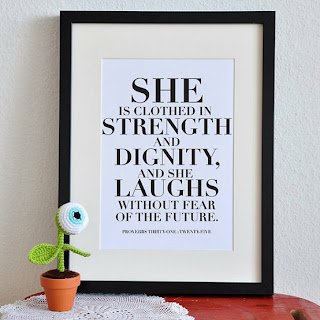
The author is able to show us in a practical way what wisdom looks like when it begins to be worked out.
So we see this nice shape to the book of Proverbs with Proverbs closing out with a final picture and powerful illustration of what wisdom looks like - seen in the noble wife of Proverbs 31.
Don't be intimidated by the Proverbs 31 woman, be inspired!
In 31:10 it says a noble woman who can find? Lots of commentators wonder if this is a cheeky question. Who can find her? Where is she? A mystery? Doesn't exists! No one can find, she doesn't exist but is rather an ideal.
Tremper Longman writes, in his commentary on Proverbs, the description is an ideal and should not be used as a standard by which to measure or critique women.
Christine Elizabeth Yoder writes, Proverbs 31:10-31 remains a portrait of the most desirable woman, an image of the ideal wife intended for a predominantly male audience... She embodies no one woman, but rather the desired attributes of many.
The reality is there isn't enough time in the day to be the Proverbs 31 woman. She is simply an ideal of what wisdom could look like in your life. Woman should grow in wisdom like the Proverbs 31 woman and SO SHOULD MEN!!!
As men grow in wisdom they should grow to become more and more like the Proverbs 31 woman.
* It's a virtuous or capable wife or husband that is worth more than precious rubies.
* A virtuous wife is trusted and enriches her husband's life.
* A virtuous husband is trusted and enriches his wife's life.
- Wisdom; not like a box of chocolates.
- Wisdom; not a grey beard, wrinkly skin, poor eyesight.
v. 21 - has no fear of winter
v.25 - laughs with no fear of the future

- dropped out of helicopters- knife, flint, drink bottle, national geographic polar fleece
- cross between MacGyver and Dr Doolittle
- doesn't have everything sorted before they drop him into the Andes, the Amazon, or the Arctic
- doesn't have a sleeping bag, tent, food, irb
- make a sleeping back out of a sheep carcass
- stuff moss down his top to keep warm
- drink his own pee to get hydrated
- eat worms, and beetles, and komodo dragons that he catches with his bare hands
Proverbs chapter 1-9 and then Proverbs 31 provide nice bookends that wrap around these pithy little wisdom sayings. They're not so much an introduction and a conclusion but they do serve to give a nice shape to the book of Proverbs.
Proverbs 1-9
Chapters 1-9 are big long speeches from a father to a son encouraging him to walk the way of wisdom rather than the way of folly. The father encourages his son to become intimately involved with woman wisdom whose lips contain wise words, who is a tree of life that leads to blessing and peace. The son is told to stay clear of woman folly, the adulterous woman, the strange or foreign woman; her lips may drip with honey but in the end they lead to destruction.
Things culminate in chapter 9 where the son is to chose who he is going to have dinner with. Who is he going to become intimately involved with, Woman Wisdom or Woman Folly?
Woman Wisdom's invitation to dinner - Proverbs 9:1-6
Woman Folly's invitation to dinner - Proverbs 9:13-18
Proverbs 10-30
Chapters 10 - 30 are quite different though. Chapters 10 -30 is a collection of hundreds of proverbs that give us little pictures and examples of what the way of wisdom is or looks like, and what they way of folly is or looks like. They cover all sorts of different areas in life. There is no particular order to them. Random pieces of advice for life circumstances that are often random and unpredictable.
Chapter 31
Then we get to chapter 31, particularly the noble woman section of the chapter in verses 10-31, what’s this all about? How is it that this passage brings a conclusion to or wraps up Proverbs as a whole? How do these verses work as a bookend that round out Proverbs so nicely? This seems a big ask of the Christian wife! Or is it something else? Potentially it's a big ask of the Christian wife!
I’ve seen in the margin of one female friend’s bible the words ‘scary’ written (as well as a bit about finding a bargain underlined). One female preacher I know joked about not preaching on the Proverbs 31 woman as she is too intimidating. She’s been described as overwhelming with her burning of the candle at both ends to the point that surely no-one can be like her.
Ultimately the woman of Proverbs 31, this noble wife, is the personification of wisdom. Not the personification of the Christian wife. She is the human embodiment of Woman Wisdom whom we learn so much about in Proverbs 1-9. The Proverbs 31 woman isn’t about the ultimate wife, it's about what wisdom will do for your life. Proverbs 31 is a depiction of wisdom not of a wife. She is the contrast of the adulterous, foreign, strange woman of Proverbs 1-9. Don't sleep with the adulterous woman of Proverbs 1-9 whose lips drip with honey. Take the noble woman of Proverbs 31 as your wife and become intimately involved with her. By personifying wisdom as a noble wife the author is able to give concrete rather than abstract examples of what wisdom will do for your life.

The author is able to show us in a practical way what wisdom looks like when it begins to be worked out.
| WISDOM | NOBLE WIFE |
| 3:14 - more profitable than silver, better returns than gold | 31:10 - worth more than precious rubies |
| 6:6 - learn from the ants don't be lazy | 31:15 - she is up before dawn preparing |
| 14:21 - blessed are those who help the poor | 31:20 - helps the poor and needy |
| 3:35 - wise possess glory | 31:23 - her husband is well known |
| 24:14 - find wisdom, have a bright future | 31:25 - laughs with no fear of the future |
| 15:7 - lips of the wise give good advice | 31:26 - words are wise and kindness in instruction |
| 1:7 - fear of the Lord is the beginning of knowledge | 31:30 - woman who fears the Lord will be praised |
So we see this nice shape to the book of Proverbs with Proverbs closing out with a final picture and powerful illustration of what wisdom looks like - seen in the noble wife of Proverbs 31.
Don't be intimidated by the Proverbs 31 woman, be inspired!
In 31:10 it says a noble woman who can find? Lots of commentators wonder if this is a cheeky question. Who can find her? Where is she? A mystery? Doesn't exists! No one can find, she doesn't exist but is rather an ideal.
Tremper Longman writes, in his commentary on Proverbs, the description is an ideal and should not be used as a standard by which to measure or critique women.
Christine Elizabeth Yoder writes, Proverbs 31:10-31 remains a portrait of the most desirable woman, an image of the ideal wife intended for a predominantly male audience... She embodies no one woman, but rather the desired attributes of many.
The reality is there isn't enough time in the day to be the Proverbs 31 woman. She is simply an ideal of what wisdom could look like in your life. Woman should grow in wisdom like the Proverbs 31 woman and SO SHOULD MEN!!!
As men grow in wisdom they should grow to become more and more like the Proverbs 31 woman.
* It's a virtuous or capable wife or husband that is worth more than precious rubies.
* A virtuous wife is trusted and enriches her husband's life.
* A virtuous husband is trusted and enriches his wife's life.
The language of Proverbs 31 is gender specific because the author is using gender specific imagery to convey the message. In understanding the message for us today though we have to understand that it is wisdom that makes a wife a virtuous and capable wife and wisdom that makes a husband a virtuous and capable husband.
Activate wisdom in your life!
Too often people fail to activate and use wisdom in their life. They wait for a sign. Too often people sit around waiting, waiting for a word from the Lord, waiting for a ‘spiritual’ encounter to motivate them to engagement, waiting as they put out a fleece and look for a sign.
Of all the ways that Proverbs could close out, of all the ways that a book addressed to young men could finish, it finishes by paralleling wisdom to a fine wife.
- Wisdom; not a tall tree growing in a forest.
- Wisdom; not like an aged wine.- Wisdom; not like a box of chocolates.
- Wisdom; not a grey beard, wrinkly skin, poor eyesight.
Nope - wisdom is like a wife, a noble wife, a companion with whom one journeys through life with. Wisdom is a companion for life like a noble husband or a noble wife is a companion for life.
Wisdom will prepare you for whatever is around the corner.
v.15 - up before dawn to prepare
v. 18 - lights burn late into the nightv. 21 - has no fear of winter
v.25 - laughs with no fear of the future
Whatever season, situation, or circumstance life brings at you, wisdom prepares you for whatever is around the corner. Not in the sense that all your t's will be crossed and your i's dotted but in the sense that whatever comes, wisdom will allow you to walk that successfully.
BearGrylls has a program called Man v Wild, in it he is...

- cross between MacGyver and Dr Doolittle
- doesn't have everything sorted before they drop him into the Andes, the Amazon, or the Arctic
- doesn't have a sleeping bag, tent, food, irb
- make a sleeping back out of a sheep carcass
- stuff moss down his top to keep warm
- drink his own pee to get hydrated
- eat worms, and beetles, and komodo dragons that he catches with his bare hands
And of course... he survives!
Wisdom is like that. It doesn't give you exactly every tool or instrument or piece of equipment that you might need for whatever the future might bring. It is though the God given ability to sort things out even though you might not have this that or the other thing.
Tuesday, 10 January 2012
A Woman's Place is in the...
In a recent book on marriage, sex and friendship by a prominent US pastor, the story of Queen Easter is referred to. The biblical character Vashti is criticized for not submitting to her husband by refusing to parade around naked in front of his drunken friends!? Meanwhile Esther is praised for graciously submitting, by illegally requesting an audience with her husband, who she was forced to marry after he slept with hundreds of other concubines to pick his favorite?! Esther is exemplified as she illustrates ‘the repeated command across all Scripture that wives respectfully submit to their husbands and removes any excuse we have for disrespecting our husbands.’ This whole argument fails massively to understand the context of that story and is picked up by Rachel Held Evans in her blog post ‘Esther and Vashti: The Real Story.’
In her post Evans makes the comment that ‘the modern biblical womanhood movement isn’t as concerned with returning to biblical womanhood as it is with returning to 1950s, pre-feminist America.’ This made me laugh and prompted me to post a couple of lines on a woman’s place actually being...

In my experience there seems to be two schools of thought in regards to biblical womanhood. One camp declares woman of God to be warrior princesses who are epitomized by the woman of Proverbs 31. They are called to be the head and not the tail, above and not beneath, the lender and not the borrower. They are to preach, teach, pray, role model, sort their home out, be beautiful, lead and basically ‘grab life by the balls.’
In her post Evans makes the comment that ‘the modern biblical womanhood movement isn’t as concerned with returning to biblical womanhood as it is with returning to 1950s, pre-feminist America.’ This made me laugh and prompted me to post a couple of lines on a woman’s place actually being...

In my experience there seems to be two schools of thought in regards to biblical womanhood. One camp declares woman of God to be warrior princesses who are epitomized by the woman of Proverbs 31. They are called to be the head and not the tail, above and not beneath, the lender and not the borrower. They are to preach, teach, pray, role model, sort their home out, be beautiful, lead and basically ‘grab life by the balls.’

There seems to be a large degree of ignorance in regards to Proverbs 31 being a personification of wisdom not of a ‘biblical’ woman. Both women and men should aspire to develop wisdom in their lives and its accompanying characteristics as described in Proverbs 31. Or, in other words, men should aspire to be Proverbs 31 women as well! This camp is obviously egalitarian and sees women and men as being equal in value and dignity, different obviously in genetic makeup etc, but more than capable of functioning in any role within society or church or the family setting.
The other camp wants women to sit in quiet submission to their husbands. Here woman are simply not allowed to preach or teach, though they can teach other woman or children, they just can’t teach men. And they are not allowed to read the bible out loud in church if you want to have a look at a link about this. This camp is obviously complementarian and hold to the view that God has created men and women equal in value and dignity and worth, but different, complementary, in function. Men have been called to exercise headship in the home and in the church while women are called to different and complementary functions. It seems to me that the different and complementary functions can be all and everything, from serving in the armed forces, to a political role such as a Prime Minister or President or Congresswoman, to being a stay home mum. Just not heading a home or a family or teaching or preaching (or reading the bible out loud) in church.
I’m obviously an egalitarian. Surely though the choice is not between Egalitarian Proverbs 31 Super Woman and Complementarian 1950’s House Wife? Not a choice between throwing woman into the lime light or hiding woman in the back ground?
My vote is for an egalitarian culture of support, encouragement, admonishment, love, grace, forgiveness, second chances, empowerment and equipping that allows women (and men) to lean into that which inspires, motivates, grips their heart, enlivens and stirs them. Let’s help both women and men to lean into the gifts, talents, abilities and deep passions that they have and to be the best in the niche that they best fit in. Let’s challenge and encourage those (women and men) that sit back when they should stand up, but not force people to be that which they are not gifted, called, inspired or motivated to be. The ideal ‘ministry couple’ is a myth.
Like for men then, a woman’s place is actually the place they feel God has called, gifted and anointed them to be. And like for men, this place is usually worked out in conversations with others, parents, one’s spouse, and with men and women of maturity. And like for anyone, age, stage, gifts, training, anointing, abilities, character, maturity etc are all factors.
Monday, 2 January 2012
TKJG Chapter 10: Creating a Gospel Culture
In this chapter McKnight sketches the gospel, the Story of Jesus completing the Story of Israel, I would say the Story of Humanity. He begins with ‘In the beginning God’ and concludes with recreation and humans governing ‘on God’s behalf in the way of Jesus. Forever.’ You’d have to get a copy of the book to read the few pages for yourself. N.T Wright tells the story in a similar manner in his thesis of the big chapters of the bible. Goheen and Bartholomew tell a similar story in The Drama of Scripture. Gabe Lyons covers it a bit in The Next Christians. Sean Gladding has The Story of God, The Story of Us. The St Luke’swebsite has it though I need to update a couple of lines (but am having technical difficulties doing so) having read this book and some others. Each story is nuanced in slightly different ways. They each tell the gospel. McKnight then encourages us to become people of the story, engage in the traditional church calendar as a way of engaging in the gospel story, realise the church is a continuation of the story, counter the stories of our contemporary context such as individualism and consumerism with the gospel story, embrace the story and be saved and transformed by Jesus as we respond to the story with faith, repentance and baptism. Bear witness to the story in serving others, love and compassion.
TKJG Chapter 9: Gospeling Today
The gospel is first of all framed by Israel’s story. Second, the gospel centres on the Lordship of Jesus. Thirdly, the gospel summons people to respond. Fourthly, the gospel saves and redeems. The gospeling of Acts summons listeners to confess Jesus as Messiah and Lord while our gospeling today tends to persuade sinners to admit their sin and find Jesus as Saviour. The later can be done within the former but too often the former is neglected. That’s not gospeling. You can’t avoid judgement in gospeling but gospeling is not simply escapism from hell, this is a distortion. Though the gospel deals with sin (and this is not intended to downplay sin), sin is not the major problem the gospel is addressing. If the major answer Jesus offers is the kingdom and eternal life, then the major issues at a stake are to do with the search for God’s kingdom on earth and the absence of God’s abundance in the worldliness of this world. Gospeling thus declares that Jesus is the rightful Lord, summons people to turn from their idols and to worship and live under that Lord who saves. When we reduce the gospel to personal salvation we tear the fabric out of the Big Story. Gospeling isn’t about the sinner’s heart it is about the risen Jesus and his story.
TKJG Chapter 8: The Gospel of Peter
Jesus’ resurrection and the profound experience with the Holy Spirit set about a ‘hermeneutical revolution’ for the apostles. They suddenly had new eyes to reread and reinterpret the Old Testament from the perspective of the Story of Jesus. Acts 13:32-33 “We tell you the good news: What God promised our ancestors he has fulfilled for us, their children, by raising up Jesus.” The apostles declare the whole story of Jesus as gospel. Peter reads a Bible (OT) that leads him to see God at work guiding the Story of Israel into the Story of Jesus. True gospeling that conforms to the apostolic gospel leads directly to who Jesus is (as the conclusion of the Israel/humanities story) and summons people to respond in faith, repentance, and baptism.
Friday, 23 December 2011
TKJG Chapter 7: Jesus and the Gospel
Did Jesus preach the gospel? Did Jesus preach himself as the completion of Israel’s story? Jesus declares himself to be at the centre of the kingdom of God, Luke 7:22-23. Jesus was totally into preaching himself as the centre of God’s plan for Israel. Jesus unequivocally and without embarrassment nominated himself as Israel’s president. Jesus in the Sermon on the Mount understood his teachings to be the consummation and completion and resolution and telos point of the Old Testament Law and the Prophets. Jesus selects 12 disciples and sees the 12 as embodying the fullness of the people of God but himself over the 12. Jesus explained his fate – his death and resurrection – in light of scripture, Daniel 7. Jesus explains himself his story, on the road to Emmaus by beginning with Moses and all the Prophets and explaining all the things the scriptures have said concerning himself, Luke 24:27. Jesus preached himself as the gospel, he was the good news and had good news as the fulfilment of Israel’s story and the inauguration of a whole new chapter of possibility and potential.
Thursday, 22 December 2011
TKJG Chapter 6: The Gospel in the Gospels
The early Christians called Matthew, Mark, Luke and John the ‘gospel’ because they are the gospel! The story of Jesus. To call these books the gospel is precisely to express that Jesus himself, the entirety of his acting, teaching, living, rising, and remaining with us is the ‘gospel.’ The four gospels and the gospel are one. The story told in Mark calls hearers to belief in the person who is described in it, Jesus, the Messiah and Son of God, and thus to eternal life; in other words it seeks to be wholly and completely a message of salvation. Luke’s purpose is not merely to narrate the deeds and words of Jesus but to show how these did in fact lead to the experience of salvation and to the formation of the community of the saved. John shows how the principle institutions and feasts of Israel, those annual celebrations that told Israel’s Story and that shaped both memory and identity for every observant Jew, fin their own completion in Jesus. These Gospels do not arrange the story into our way of framing the plan of salvation, and neither do they format the story into our favourite method of persuasion. Instead they declare the Story of Jesus, and that story is the saving, redeeming, liberating story.
TKJG Chapter 5: How Did Salvation Take Over the Gospel?
The creeds articulate what is both implicit and explicit in Paul’s grand statement of the gospel in 1 Corinthians 15. Thus, the gospel is the Story of Jesus as the completion of the Story of Israel as found in the Scriptures, and that gospel story formed and framed the earliest Christians. During the much needed and God ordained Reformation, salvation was clarified in regards to its personal application and necessity. What then happened overtime is that the apostolic gospel was reframed in such as way and so successfully (largely as a result of the powerful evangelistic culture of evangelicalism in American revivalism and then later in America’s culture war between fundamentalists and modernists), that today we are losing contact with the gospel culture.
Tuesday, 20 December 2011
Advent 4
Advent is a four week season that provides is with the opportunity to celebrate the excitement, anticipation and sense of expectation that comes with Christmas.
Not excitement and anticipation because of all the trappings of Christmas that most of us are largely familiar with – Santa sacks, presents, sweet treats, family fun, festivities, fine food, indulgence, holidays, summer, BBQ’s and all those things we associate with a Kiwi Christmas. As good as what they all might be (and obviously this things can all be distorted to actually take away from Christmas rather than add to it), this isn’t what we get excited about during Advent and at Christmas.
The excitement, celebration and anticipations centres on the coming of Jesus...

External to our efforts, to our striving, to our will power, to our best intentions, and New Year’s resolutions we celebrate that a new chapter has begin in Jesus Christ. All we have to do is get lost and found in the story of Jesus.
That’s what a Christian is, that’s what a Christ follower is someone who’s whole life is caught up and shaped by God’s big story and the life changing work of Jesus Christ in coming and making a new chapter possible for all humanity.
Not excitement and anticipation because of all the trappings of Christmas that most of us are largely familiar with – Santa sacks, presents, sweet treats, family fun, festivities, fine food, indulgence, holidays, summer, BBQ’s and all those things we associate with a Kiwi Christmas. As good as what they all might be (and obviously this things can all be distorted to actually take away from Christmas rather than add to it), this isn’t what we get excited about during Advent and at Christmas.
The excitement, celebration and anticipations centres on the coming of Jesus...
· Jesus’ coming 2000 years ago
· Jesus’ desire to come and work in our lives today
· Jesus’ coming to restore and to put all things right
Often in our 21st Century context we wait until the New Year to turn over a new leaf, to enter a new chapter in life. Today isn’t they day for that, no way. LOL. But somehow the transition from the 31/12 to 01/01 is the time! Now we’ll lose weight, get fit, take up a hobby, give up a vice, read the bible every day, make church attendance a weekly habit, quit smoking or whatever it might be. Now is the moment to summon our will power, our mental reserves, to get committed, to find an accountability partner, to psyche oneself up, to turn a new page, starts a new chapter and begin a new life!
It’s a bit crazy that we wait to the 31st December to do this, but it kind of makes sense.
The Christian New Year isn’t January 1 though. The Christian New Year, the Christian Liturgical Calendar, kick starts the New Year at the end of November, the fourth Sunday before Christmas. That’s when we say happy New Year.
Here though we don’t hope that the New Year will bring a new chapter and a different story into reality in our life; we celebrate with excitement and anticipation that a new chapter has begun and will continue to be!

External to our efforts, to our striving, to our will power, to our best intentions, and New Year’s resolutions we celebrate that a new chapter has begin in Jesus Christ. All we have to do is get lost and found in the story of Jesus.
ADVENT – A new chapter is coming, let’s get ready, let’s celebrate.
CHRISTMAS – A new chapter has begun.
CHRISTMAS – A new chapter has begun.
That’s the excitement and anticipation of Advent and of Christmas, there is a new chapter in the story, a new chapter in the story of humanity and there can be a new chapter in the story of my life as well. And that new chapter is here today!
Lost – found
Brokenness and strife – something beautiful
Despair, anxiety, hopelessness – peace, confidence and hope
Pain and heartache – healing and restoration
Brokenness and strife – something beautiful
Despair, anxiety, hopelessness – peace, confidence and hope
Pain and heartache – healing and restoration
We sing about this in some of our Christmas carols...
O Holy Night
Long lay the world in sin and error pining.
Till He appeared and the Spirit felt its worth.
A thrill of hope the weary world rejoices,
for yonder breaks a new and glorious morn.
Till He appeared and the Spirit felt its worth.
A thrill of hope the weary world rejoices,
for yonder breaks a new and glorious morn.
In all our trials born to be our friends
He knows our need, our weakness is no stranger.
He knows our need, our weakness is no stranger.
Truly He taught us to love one another,
His law is love and His gospel is peace.
Chains he shall break, for the slave is our brother.
And in his name all oppression shall cease.
Joy to the World
No more let sins and sorrows grow,
Nor thorns infest the ground;
He comes to make His blessings flow
Far as the curse is found,
Far as the curse is found,
Far as, far as, the curse is found.
ADVENT – A new chapter is coming, let’s get ready, let’s celebrate.
CHRISTMAS – A new chapter has begun.
His law is love and His gospel is peace.
Chains he shall break, for the slave is our brother.
And in his name all oppression shall cease.
Joy to the World
No more let sins and sorrows grow,
Nor thorns infest the ground;
He comes to make His blessings flow
Far as the curse is found,
Far as the curse is found,
Far as, far as, the curse is found.
ADVENT – A new chapter is coming, let’s get ready, let’s celebrate.
CHRISTMAS – A new chapter has begun.
BAPTISM – we’ve entered into a new story.
We’ve put our faith and trust in Jesus, we’ve turned from living life our own way and we’ve chosen to live in the light of God’s big story, to get lost and found in God’s big story. We die with Christ and we are raised to new life with Christ!That’s what a Christian is, that’s what a Christ follower is someone who’s whole life is caught up and shaped by God’s big story and the life changing work of Jesus Christ in coming and making a new chapter possible for all humanity.
Look forward to the possibility of a new chapter in your life this Advent.
Celebrate the dawning of a new day, of a new chapter, because of Jesus this Christmas.
Put your faith and trust in Jesus, turn to follow him as King, enter a new chapter in Baptism.
Celebrate the dawning of a new day, of a new chapter, because of Jesus this Christmas.
Put your faith and trust in Jesus, turn to follow him as King, enter a new chapter in Baptism.
TKJG Chapter 4: The Apostolic Gospel of Paul
1 Corinthians 15 is the best place to begin mapping an understanding of the gospel. Here Paul comes pretty close to defining the word gospel. The gospel is to announce good news about the key events in the life of Jesus and to shout aloud the Story of Jesus Christ as the saving news of God. The gospel though is intimately tied to Israel’s Story as found in the scriptures of the Old Testament. Salvation – the robust salvation of God – is the intended result of the gospel story about Jesus Christ that completes the story of Israel in the Old Testament.
1 Corinthians 15 (TNIV)
PART A
1 Now, brothers and sisters, I want to remind you of the gospel I preached to you, which you received and on which you have taken your stand. 2 By this gospel you are saved, if you hold firmly to the word I preached to you. Otherwise, you have believed in vain. (15:1-2)
PART B
3 For what I received I passed on to you as of first importance: that Christ died for our sins according to the Scriptures,
4 that he was buried,
that he was raised on the third day according to the Scriptures, 5 and that he appeared to Cephas, and then to the Twelve.(15:3-5)
PART C
20 But Christ has indeed been raised from the dead, the firstfruits of those who have fallen asleep. 21 For since death came through a human being, the resurrection of the dead comes also through a human being. 22 For as in Adam all die, so in Christ all will be made alive. 23 But in this order: Christ, the firstfruits; then, when he comes, those who belong to him. 24 Then the end will come, when he hands over the kingdom to God the Father after he has destroyed all dominion, authority and power. 25 For he must reign until he has put all his enemies under his feet. 26 The last enemy to be destroyed is death. 27 For he “has put everything under his feet.” Now when it says that “everything” has been put under him, it is clear that this does not include God himself, who put everything under Christ. 28 When he has done this, then the Son himself will be made subject to him who put everything under him, so that God may be all in all. (15:20-28)
1 Corinthians 15 (TNIV)
PART A
1 Now, brothers and sisters, I want to remind you of the gospel I preached to you, which you received and on which you have taken your stand. 2 By this gospel you are saved, if you hold firmly to the word I preached to you. Otherwise, you have believed in vain. (15:1-2)
PART B
3 For what I received I passed on to you as of first importance: that Christ died for our sins according to the Scriptures,
4 that he was buried,
that he was raised on the third day according to the Scriptures, 5 and that he appeared to Cephas, and then to the Twelve.(15:3-5)
PART C
20 But Christ has indeed been raised from the dead, the firstfruits of those who have fallen asleep. 21 For since death came through a human being, the resurrection of the dead comes also through a human being. 22 For as in Adam all die, so in Christ all will be made alive. 23 But in this order: Christ, the firstfruits; then, when he comes, those who belong to him. 24 Then the end will come, when he hands over the kingdom to God the Father after he has destroyed all dominion, authority and power. 25 For he must reign until he has put all his enemies under his feet. 26 The last enemy to be destroyed is death. 27 For he “has put everything under his feet.” Now when it says that “everything” has been put under him, it is clear that this does not include God himself, who put everything under Christ. 28 When he has done this, then the Son himself will be made subject to him who put everything under him, so that God may be all in all. (15:20-28)
Monday, 19 December 2011
TKJG - Chapter 3: From Story to Salvation
The gospel only makes sense in the context of the full narrative of Christian scripture; if we ignore this larger story the gospel gets distorted. But that full narrative is not the gospel. The gospel is the story of Jesus as the resolution of Israel’s (humanities) story. This story includes how someone is ‘saved’ but any personal plan for or of salvation in itself is not the gospel and becomes a distortion of the gospel. God’s righteousness and holiness, our sin, Christ’s atoning death, and our response of repentance and faith in Jesus is not the gospel. A salvation plan leads to justification. The gospel though includes salvation but leads to discipleship, justice, goodness and loving kindness.
Saturday, 17 December 2011
TKJG – Chapter 2: Gospel Culture or Salvation Culture
Personal faith is both necessary and nonnegotiable; the gospel doesn’t work for spectators you have to participate. Evangelicals though are not really ‘evangelical’ in the sense of the apostolic gospel but instead are soterians. The word gospel is mistakenly equated with the word salvation, but these two words don’t mean the same thing. In thinking salvation as identical to gospel we betray a profound lack of awareness as to what the gospel means and what the gospel might mean for our world today.
Friday, 16 December 2011
TKJG - Chapter 1: The Big Question
In the following series of posts I'll attempt in 100 words or less to summarize each chapter of The King Jesus Gospel by Scot McKnight.
Here we go...
The big question in Christian circles that needs addressing is ‘what is the gospel?’ We need to go back to the bible and ask ourselves this question all over again, as if we were in Galilee listening to Jesus ourselves or as if we were the first listeners of the apostles preaching in some small house church in the middle of the Roman Empire. The word ‘gospel’ has been hijacked by what we believe about ‘personal salvation.’ The result being that the word gospel no longer means in our world what it originally meant to Jesus or the apostles.
Here we go...
The big question in Christian circles that needs addressing is ‘what is the gospel?’ We need to go back to the bible and ask ourselves this question all over again, as if we were in Galilee listening to Jesus ourselves or as if we were the first listeners of the apostles preaching in some small house church in the middle of the Roman Empire. The word ‘gospel’ has been hijacked by what we believe about ‘personal salvation.’ The result being that the word gospel no longer means in our world what it originally meant to Jesus or the apostles.
Thursday, 15 December 2011
The King Jesus Gospel
I've just started reading The King Jesus Gospel by Scot McKnight. The forewords are from N.T. Wright and Dallas Willard.

Here are snippets of what they have to say...
N.T. Wright
God wants every single Christian to grow up in understanding as well as trust, the Christian faith has never been something that one generation can sort out in such as way as to leave their successors with no work to do.
We shouldn't be alarmed if someone sketches a third, fourth, or even fifth dimension that we had overlooked. (This is in regards to our understanding of Christianity and Christian faith).
The movement that has long called itself "evangelical" is in fact better labelled "soterian."
"The gospel" is the story of Jesus of Nazareth told as the climax of the long story of Israel, which in turn is the story of how the one true God is rescuing the world.
For many people, "the gospel" has shrunk right down to a statement about Jesus' death and its meaning, and a prayer with which people accept it. That matters, the way the rotor blades of a helicopter matter. You won't get of the ground without them. But rotor blades alone make a helicopter.
This book could be one of God's ways of reminding the new generation of Christians that it has to grow up to take responsibility for thinking things through afresh, to look back to the large world of the full first-century gospel in order then to look out on the equally large world of twenty-first-century gospel opportunity.
Dallas Willard
Scot McKnight here presents, with great force and clarity, the one gospel of the bible and of Jesus the King and Savior. He works from the basis of profound biblical understanding and of insight into history and into the contemporary misunderstandings that produce gospels that do not normally produce disciples, but only consumers of religious goods and services. In the course of this he deals with the primary barrier to the power of Jesus' gospel today - that is, a view of salvation and of grace that has no connection with discipleship and spiritual transformation. It is a view of grace and salvation that, supposedly, gets one ready to die, but leaves them unprepared to live now in the grace and power of resurrection life.
It would probably be worth your while getting a copy of the book and having a read don't you think?

Here are snippets of what they have to say...
N.T. Wright
God wants every single Christian to grow up in understanding as well as trust, the Christian faith has never been something that one generation can sort out in such as way as to leave their successors with no work to do.
We shouldn't be alarmed if someone sketches a third, fourth, or even fifth dimension that we had overlooked. (This is in regards to our understanding of Christianity and Christian faith).
The movement that has long called itself "evangelical" is in fact better labelled "soterian."
"The gospel" is the story of Jesus of Nazareth told as the climax of the long story of Israel, which in turn is the story of how the one true God is rescuing the world.
For many people, "the gospel" has shrunk right down to a statement about Jesus' death and its meaning, and a prayer with which people accept it. That matters, the way the rotor blades of a helicopter matter. You won't get of the ground without them. But rotor blades alone make a helicopter.
This book could be one of God's ways of reminding the new generation of Christians that it has to grow up to take responsibility for thinking things through afresh, to look back to the large world of the full first-century gospel in order then to look out on the equally large world of twenty-first-century gospel opportunity.
Dallas Willard
Scot McKnight here presents, with great force and clarity, the one gospel of the bible and of Jesus the King and Savior. He works from the basis of profound biblical understanding and of insight into history and into the contemporary misunderstandings that produce gospels that do not normally produce disciples, but only consumers of religious goods and services. In the course of this he deals with the primary barrier to the power of Jesus' gospel today - that is, a view of salvation and of grace that has no connection with discipleship and spiritual transformation. It is a view of grace and salvation that, supposedly, gets one ready to die, but leaves them unprepared to live now in the grace and power of resurrection life.
It would probably be worth your while getting a copy of the book and having a read don't you think?
Subscribe to:
Posts (Atom)